The Most In-Demand Finance Jobs in Ireland for 2026 – and What to Expect

As we step into 2026, finance jobs in Ireland are being reshaped by economic shifts, evolving skillsets, and regional dynamics. While market conditions remain competitive, fresh opportunities are emerging, from part-qualified roles to senior advisory positions. Whether you’re hiring into your finance team or considering your next move as an accountant, understanding what’s driving Irish market trends is critical.

We draw on the latest salary data, industry reports, and our real-time insight from working with employers and professionals across the country to explore which finance jobs are most in demand, where the opportunities lie, and what both clients and candidates can expect in the year ahead.

Jump To

Market Overview. What Changed in 2025?
The Most In-Demand Finance Jobs for 2026
Regional Trends Across Ireland and Northern Ireland
Key Focus Areas for Employers and Candidates
Get In Touch with Martina Quinn Finance Recruitment

Market Overview. What Changed in 2025?

2025 was marked by cautious optimism, and as we move into the New Year this mood continues. According to recent research by Deloitte, over 70% of Irish CFOs expect their company’s revenue to increase in 2026, with nearly a third feeling more confident about their organisation’s financial future than just three months ago.

In the Republic of Ireland, salary levels remained competitive, particularly in areas like FP&A, payroll, and regulatory reporting. Notably, tech skills, ESG exposure, and systems experience (like SAP S/4HANA) became increasingly valuable as finance teams adapted to automation and digital transformation.

Meanwhile, Northern Ireland’s financial services sector outpaced other UK regions in growth, with demand for professionals skilled in ESG/CSRD reporting and ERP system migration remaining strong, particularly in Belfast.

The Most In-Demand Finance Jobs for 2026

Based on our recruitment activity and the latest salary benchmarks, here are the finance jobs seeing the most traction right now.

1. Part-Qualified and Support Roles
These continue to be a cornerstone of finance hiring in 2026. Employers value candidates with strong Excel, system migration, and automation experience. Part-qualified professionals with exposure to Power BI and SQL are especially in demand as finance teams shift toward a more analytical function.
2. FP&A and Commercial Finance
Professionals who can translate numbers into strategic insight are in high demand. FP&A roles have seen a notable salary uplift, especially in sectors like manufacturing, aviation, and IT. Strong forecasting, budgeting, and business partnering skills are essential.
3. Audit and Advisory
Audit professionals with Big 4 or mid-tier backgrounds are actively being recruited into both practice and industry roles. Internal audit, transaction services, and risk assurance continue to offer strong progression paths, especially for those looking to step into more commercial environments.
4. Payroll and Shared Services Leaders
With multinational firms expanding operations across Ireland, payroll managers with international scope and SOX compliance experience are highly sought after. Those who can lead transformation or automation projects are commanding premium salaries.
5. Financial Controllers and Finance Managers
These remain key strategic hires for growth-stage companies and larger corporates alike. There’s particularly strong demand for commercially focused FCs with team leadership and systems change experience.

The finance jobs market across Ireland is not uniform with notable regional variations shaping opportunities and salaries.

Dublin remains the salary frontrunner, offering rates that are 7–10% higher than elsewhere in the country. However, there is also strong hiring activity beyond the capital, particularly in Limerick, Galway, and Cork, where demand is rising for finance professionals in the manufacturing and pharmaceutical sectors.

Northern Ireland, meanwhile, continues to experience rapid growth in financial services, but a salary gap persists, with roles in Ireland commanding up to 25% more. That said, the presence of multinational employers in Belfast is helping to narrow this divide, especially for those with ESG and regulatory reporting expertise.

For candidates willing to relocate or commute cross-border, finance jobs in areas such as payroll, financial reporting, and FP&A offer compelling career opportunities across both jurisdictions.

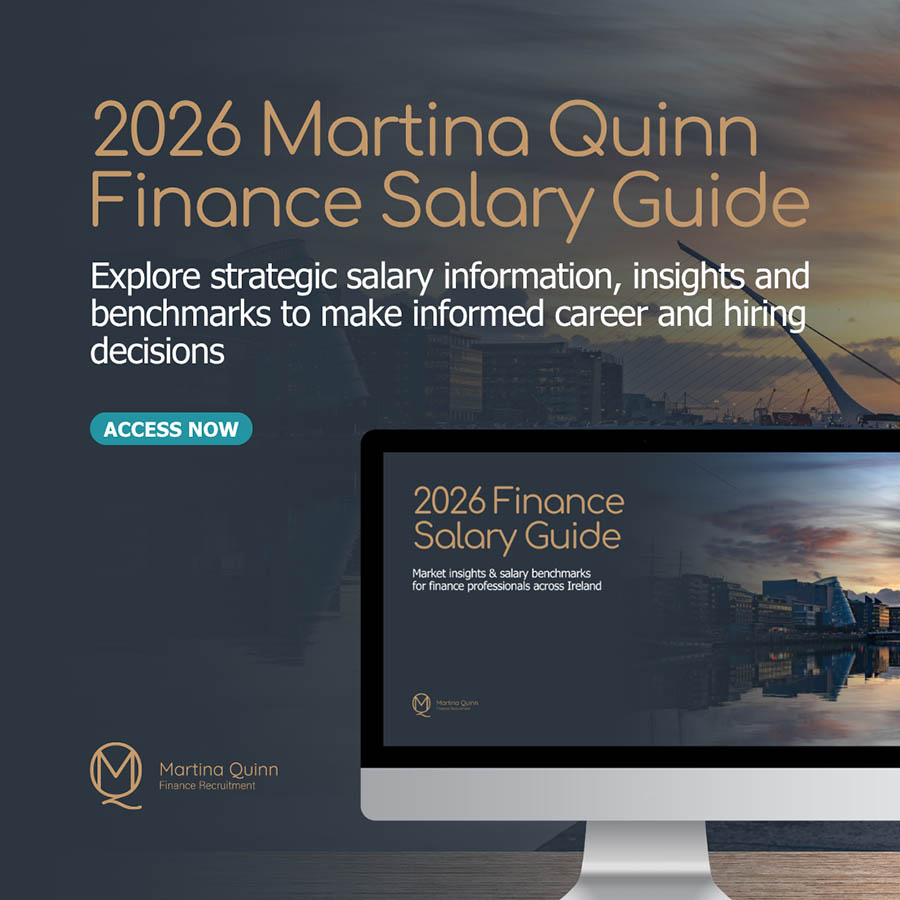
Download the 2026 Salary Guide

Want to explore the full salary ranges for accountant jobs and senior finance roles across Ireland and Northern Ireland?

Download the full guide here for detailed salary tables, benefits trends, and regional comparisons.

What Employers and Candidates Should Focus on in 2026

For Employers:

Refine your briefs: Vague or overly complex job specs are still costing teams great candidates. A concise, realistic role brief will attract better talent faster.
Speed up processes: The best candidates often receive multiple offers. Shortlisting and feedback timelines matter more than ever.
Invest in retention: Employers offering mentoring, hybrid flexibility, and clear progression plans are winning the war for talent.
Embrace tech skills: Prioritise candidates with data literacy and ERP experience—even in traditional roles like AP/AR or payroll.

For Candidates:

Build your commercial acumen: Whether you’re newly qualified or experienced, the ability to link financial data to business impact is key to standing out.
Get interview ready: With companies placing more weight on cultural fit, prepare for interviews that go beyond technical ability.
Understand your value: Use our salary guide to benchmark your expectations and confidently negotiate offers.
Stay open to sector shifts: Many roles in aviation, tech, and manufacturing now favour candidates from diverse financial backgrounds.

Let’s Talk About Your 2026 Finance Hiring or Career Plans

Whether you’re building out a finance team or preparing for your next move as an accountant, we’re here to help. At Martina Quinn Finance Recruitment, we offer consultative support grounded in real market insight and senior-level expertise.


Contact us today to explore our finance recruitment services or to receive tailored career advice from our team.

Why ESG and CSRD Expertise Is Essential for Today’s Finance Teams

Organisations and finance leaders are facing a new wave of challenges and opportunities closely linked to their ability to align operations with environmental, social, and governance (ESG) principles. A key driver of this shift is the upcoming CSRD (Corporate Sustainability Reporting Directive) reporting requirements in Ireland.

These regulations, which mandate comprehensive and standardised sustainability reporting, are changing how companies approach their financial reporting and governance structures. As a result, finance professionals with a strong understanding of ESG and CSRD are becoming increasingly sought after, as they play a critical role in ensuring compliance and driving strategic growth. However attracting and retaining these skills is not always straightforward.

Jump to

Why Prioritise ESG and CSRD Expertise
The Impact of CSRD Regulations on Finance Functions
Benefits of ESG Competencies for Businesses
Attracting and Retaining Talent with ESG and CSRD Expertise

Why Finance Leaders Need to Prioritise ESG and CSRD

For businesses in Ireland, CSRD reporting requirements are now an inescapable reality. The regulations, which will impact over 50,000 companies across Europe, requires organisations to:

Disclose detailed information on how their activities impact the environment, society, and governance, including the risks and opportunities related to sustainability.
Include ESG data in their traditional financial reporting, giving a holistic view of the organisation’s performance.
Provide assurance on sustainability reports via external verification, similar to that applied to financial audits.
Bring reporting in line with EU-wide reporting standards allowing for consistency and comparability across companies.
Address how climate-related risks affect their business model and operations, and include governance structures for managing these risks.
Evaluate and report on the ESG performance of their supply chains, ensuring transparency and accountability across all business relationships.
Depending on the size and type of business, organisations must meet specific deadlines for submitting their sustainability reports, with larger businesses facing earlier reporting timelines.

The Impact of CSRD Regulations on Finance Functions

A move towards stricter ESG regulation in Ireland via the CSRD’s rigorous reporting requirements will have a direct impact on finance functions. Finance teams must now:

Integrate Non-Financial Data

It is now a requirement to include non-financial data, such as sustainability metrics, within financial reports to comply with CSRD standards. This will not only increase the volume of work but will also necessitate new skills, tools, and interdepartmental collaboration to ensure compliance.

Incorporate Sustainability Goals into Corporate Strategy

With 82% of investors seeking greater integration of ESG considerations into corporate strategies, teams must ensure that sustainability objectives are embedded within the overall business strategy.

Ensure Sustainability Reporting is on Par with Financial Audits

Companies must demonstrate a clear commitment to sustainability by providing assurance on sustainability reports, at the same level of rigor as financial audits.

Develop Talent Strategies to Support ESG Reporting

It is now crucial for businesses to recruit finance professionals with both traditional financial expertise and the technical skills necessary for navigating complex ESG reporting frameworks. We are already beginning to see the impact here as evidence shows 62% of organisations have begun assigning sustainability responsibilities to C-suite roles.

Benefits of ESG Competencies for Businesses

For organisations in Ireland, the adoption of new CSRD reporting standards provides numerous advantages, both immediate and long-term. Here are some key benefits:

1. Regulatory Compliance
Ensuring compliance with EU’s CSRD reporting requirements is not optional. Failing to meet these standards could result in penalties and reputational damage. Finance professionals with expertise in ESG reporting will be able to guide businesses through these complex regulations, reducing the risk of non-compliance.
2. Investor Confidence
As sustainability becomes a key factor in investment decisions, companies that can demonstrate solid ESG credentials will attract more investment. Investors are increasingly looking for transparency and measurable impact when it comes to environmental, social, and governance practices.
3. Strategic Growth
ESG expertise in the finance team enables businesses to identify opportunities for strategic growth aligned with sustainability goals. This might include new revenue streams, improved operational efficiencies, and enhanced stakeholder relationships. Understanding how ESG impacts financial performance can help businesses pivot in ways that open up new growth avenues.
4. Brand Reputation and Trust
Consumers and employees alike are increasingly prioritising sustainability. By prioritising ESG and aligning with CSRD reporting standards, businesses not only comply with regulatory requirements but also build a reputation as a responsible corporate entity. This trust can be a key differentiator in a competitive market.

How To Attract and Retain Finance Talent with ESG and CSRD Expertise

Employers need to act quickly to secure finance talent with ESG and CSRD knowledge. However, finding the right candidates requires more than just a technical skills match.

Here are some steps you can take to ensure you attract and retain the best professionals:

1. Look Beyond Traditional Financial Expertise
It’s essential to look for candidates who not only have a strong financial background but also a proven track record in ESG. Candidates with experience in sustainability reporting or those who have worked with international standards such as the Global Reporting Initiative (GRI) or the Task Force on Climate-related Financial Disclosures (TCFD) will be valuable assets to any team.
2. Cultural Fit is Key
ESG compliance requires creating a culture that values sustainability. Look for candidates who are passionate about environmental and social issues, as their commitment will inspire others within the company. A strong cultural fit is essential for long-term success in driving sustainability initiatives forward.
3. Invest in Continuous Learning and Development
ESG and sustainability regulations are constantly evolving. Offering ongoing training and professional development opportunities in ESG compliance and CSRD reporting is a great way to ensure your team remains ahead of the curve.
4. Use Specialised Recruitment Agencies
Working with a specialist recruitment firm like Martina Quinn Finance Recruitment can help employers connect with exceptional candidates with the unique skill sets needed for ESG and CSRD compliance.

Demand for finance professionals with ESG and CSRD expertise is growing, and businesses that fail to adapt to these changes risk falling behind. These competencies are now critical not only for compliance but also for business growth, investor relations, and brand reputation.

If you’re looking to find talented senior and mid-level finance professionals with ESG and CSRD expertise, Martina Quinn Finance Recruitment is here to help. Our extensive network and understanding of the finance and sustainability sectors, we can help you secure the right candidates to drive your business forward.

Contact us today to discuss how we can assist with your recruitment needs.

Quarterly Talent Market Insights: Accountancy & Finance

Get Your Exclusive Insight into What’s Driving Recruitment Across Ireland

Staying ahead in Ireland’s ever-competitive finance market requires an understanding of the trends shaping the salaries and benefits on offer.

Our Quarterly Talent Market Insights for Accountancy & Finance offers an essential overview of the industry shifts driving hiring, compensation structures and benefits informed by industry professionals and recruitment experts.

It’s designed to help finance professionals and employers alike make informed decisions by showcasing sector-specific expectations and strategies for recruitment and retention.
Don’t miss out on this opportunity to gain valuable knowledge to optimise your hiring processes and career decisions.

What’s Inside?

Detailed market breakdowns for Dublin, Northern Ireland, and the rest of Ireland.
Insights into emerging trends, such as the rise in hybrid working and the demand for experienced finance leaders.
Key strategies to help both professionals and employers navigate the talent market.

Key Highlights from the Quarterly Insights Guide

Northern Ireland

Base pay levels have stabilised, but total reward packages including flexible/hybrid work, healthcare, enhanced annual leave, and professional development are increasingly important.
Strong demand in shared services, manufacturing & engineering, public & not-for-profit sectors, and technology finance roles with automation and systems expertise.

Finance professionals with data analytics, ERP, and automation skills command salary premiums.
Hybrid work (2-3 days in office) is now a standard expectation, widening talent pools and improving retention.

Republic of Ireland

Dublin remains highly competitive with moderated salary inflation but strong demand for niche skills like FP&A, finance business partnering, data analytics, ERP, and automation.
Sector hotspots include Tech & FinTech, Pharma & Life Sciences, and Construction & Real Estate.
Flexible working and wellness benefits are key differentiators alongside competitive pay.
Outside Dublin, regions like Cork, Limerick, and Galway show steady growth with strong demand in med-tech, manufacturing, shared services, and scaling SMEs.
Hybrid work is established but more varied regionally, with shorter commutes and work-life balance highly valued.

Download the Report

Access the full Quarterly Talent Market Insights here:
Quarterly Talent Market Insights: Accountancy & Finance

Salary Benchmarking

For detailed salary benchmarking and to explore salary ranges by role and region, visit our dedicated 2026 Salary Guide landing page:
Explore the 2026 Salary Guide

The Best Accounting and Finance Recruitment Trends in 2023 To That You Need To Know – Top 5

Top 5 Accounting & Finance Trends in 2023

The current accounting and finance recruitment trend for 2022 is set to to continue for 2023. Job seekers should be aware that the current lack of accessible competent qualified professionals makes it a candidate’s hiring market.

Many businesses are employing new personnel and growing their operations despite the pandemic’s lasting affects and economic factors like rising inflation. According to new figures from the Central Statistics Office show that 2.55 million people were employed in the State in the second quarter of this year.

In some industries it is especially difficult to find candidates due to skills shortages. Companies are enticing top workers to join their company by offering signing bonuses, financial incentives, additional paid time off, and job title changes, to name just a few. All of these tactics, as well as others, are ones many of us are familiar with. These options, nevertheless, are frequently insufficient, especially if the option of working remotely is not provided.

Remote work is and will become a popular benefit in accounting and finance for 2023

Having stated that, here is a suggestion for candidates: Keep an open mind on the “where” of job if you want to increase your employability. Many organisations are attempting to decide if they want to continue using a remote, hybrid, or in-office strategy in the future. Therefore, being open to several possibilities may help you find employment opportunities. However, you should also be up forward about your preferences and underline that, when the time is appropriate, you’d like to discuss a flexible work schedule.

Accounting and Finance Recruitment Trend 1

Remote Workforce

Traditional employment is evolving. Businesses are benefiting from the fact that employees are no longer confined to an actual office. The accounting sector is one that can accomplish it more easily than others and is not an exception to this rule. Due to the epidemic and the use of cloud-based software, an increasing number of accountants are working remotely, enabling staff to fulfill their allocated jobs without being in the same building.

Accounting and Finance Recruitment Trend 2

AI & Automation

The practice of manually entering data into spreadsheets is quickly becoming obsolete. To save time and money, accounting businesses that want to remain competitive need to automate as many of their operations as they can. Workflows for approval, bank reconciliation, journal entries, inter-company consolidation, revenue recognition, lease accounting, and depreciation are a few of the activities being automated.

Accounting and Finance Recruitment Trend 3

Big Data Combined With Analytics & Forecasting

The demand for accountants who can properly manage and analyze data has expanded along with data complexity. To help them make sense of the wealth of information at their fingertips, businesses and accounting firms are seeking people with strong data analytics abilities and experience. Accountants need to employ advanced analytics and forecasting methods in addition to big data. In the subject of accounting, there is a clear need for data specialists.

Accounting and Finance Recruitment Trend 4

Utilising The Cloud

Accounting firms are following suit to satisfy the needs of organizations that are migrating to the cloud at an increasing rate. These businesses may access their data from any device with an internet connection thanks to cloud-based accounting solutions. This is a great choice for businesses with numerous locations or remote workers. From a financial perspective, there is a need for employees with cloud capabilities and AI automation.

Accounting and Finance Recruitment Trend 5

Diverse Range Of Skills

Employers are looking for accountants with a variety of talents to stay up with the evolving accounting landscape. Accounting is no longer just about creating financial statements and tax returns as more transactional activity is automated. Accountants who want to succeed need to know how to use technology, comprehend data analytics, and interact with clients well. this where your soft skills come into play.

Our Solutions.

Martina Quinn Finance Recruitment specialises in the placement of qualified accountants up to executive level nationwide, Our teams have extensive experience (67 years combined) recruiting in the Irish Market. Reach out to the team here in Martina Quinn Finance Recruitment for the best advice and support in building your finance teams contact us today.

8 Practical Reasons To Change Your Secure Accounting Job

The market is an accounting  jobseekers market right now
The market is a jobseekers market right now

Why didn’t you change your accounting job this year? What is preventing you from seeking out a new position that better satisfies your needs? A position offering greater compensation, benefits, flexibility, and career prospects?

We switched from a employers to a job seekers market over the last two years. There has been a change from candidates almost being able to pick and choose where they can work. Accounting jobs are plentiful but there is a shortage of supply of fully qualified accountants.

Right now, the Great Resignation, the skills gap, and Covid’s effects are causing the personnel scarcity to spread to numerous other industries. Employers’ difficulties in hiring are not improving. Particularly for hiring managers in the finance industry, where 82% of them cite hiring accountants as their greatest challenge..

Just over two years ago we were being warned by the ERSI that we will face the largest recession in history when lockdown was being implemented. However, the post-Covid economic collapse that was expected never happened. In actuality, the opposite happened.

According to Irishjobs.ie, the job market is still expanding strongly in the majority of sectors, with job openings rising 119% on a yearly basis. All these facts lead us to ask our original question Why didn’t you change your accounting job this year? Below is our list of 8 reasons why you should change your secure accounting job.

The Skills Gap Within Accounting Jobs

The majority of LinkedIn users move jobs, companies, or industries every 4 years, making it the exception rather than the rule to stay with one for your whole career. Staying in the same role for many years often leaves employees unmotivated, uninspired and performance levels don’t reach levels required. Often accountants are over worked due skills shortages to meet the demands within the industry.

Flexible Work Options

Employers are not just expanding the work-from-home model because many employees are eager to return to the workplace. You can customise flexible work to meet your needs for a healthy work-life balance. This can range from an individualized hybrid working paradigm to working periodically during the year from a different country.

Employers are paying closer attention to what their employees require. And instead of the conventional expectation that individuals fit their lives around their job duties, they are enabling people to fit their work around their lives.

Increased Annual Leave Days

Many employers are providing more days off for their staff. Some examples include having your birthday off. Multinationals such as Netflix have adopted an unlimited time off policies.

4 Day Workweek

A four-day workweek is an experiment being conducted by Kickstarter and other businesses. Employees are expected to work just as hard and will be paid equally. Trials conducted in Iceland between 2015 and 2019 revealed that production remained constant or even rose. Future-thinking companies should be open to negotiating a four-day workweek as further experiments are conducted in Spain and New Zealand.

Well-being and Mental Health

The pandemic has really brought attention to the importance of mental health and wellness. A crucial first step for managers and HR (Human Resource) is acknowledging the stress that employees are experiencing. Providing resources to assist workers in coping with burnout and other mental health concerns is also important.

Increased leave and flexibility as well as mental health treatment through wellness are crucial strategies for reducing work-related stress. Nowadays, it makes sense to have a solid wellness program that allows employees to have a better work-life balance.

Joining a gym or participating in other activities should be included of employee benefits packages. Think about your priorities and bring them up when dealing with recruiting managers or recruiters.

Access To Accounting Leadership

Employees anticipate that their profession will matter and have meaning. People who are happier, healthier, and less prone to switch roles at work are more productive.


People can better comprehend the purpose of their job by having access to leadership and decision-makers. They can also coordinate their individual ambitions with those of the businesses. It offers workers a strong sense of belonging, which raises morale, and it enables leadership to receive sincere input.

Continuous Accounting Professional Development

A business catchphrase is now “learning is a lifelong process.” The half-life of a taught talent is five years, and for good reason. As automation and the impact of technology increase, “major changes to the working environment” will occur during the next ten years and what it means for accounting jobs.


Success requires ongoing skill development. However, balancing L&D with the demands of work and life can be quite difficult. especially if workers believe the options aren’t sufficient to suit their needs.
Personalized L&D packages with predetermined time and financial budgets are less of a perk and more of a need. Especially for businesses trying to hire and keep talented, engaged, and motivated staff.

Family Care

Women make about 80% of people exiting the workforce. The quantity of household and childcare work that women are expected to perform after working a full day at the office is one of the key contributors.
Employers looking to retain this talent or attract women who are on the verge of quitting their jobs can provide family-related benefits.

Consider these three crucial areas: childcare support (whether financial or time-related). giving upskilling more time to resume their work after a break equal parental leave for men and women would level the playing field.

Stock Purchase Options

An established business with consistent development and obvious career advancement offers a sense of long-term security that a start-up simply cannot match.
Thomas Jefferson is credited with saying, “With great danger comes great profit,” though. It takes a strong person to take the risk of joining a newly founded firm with enormous aspirations, endless possibility, and an uncertain course.

However, especially in terms of stock options, the rewards might be amazing. a benefit that many start-ups provide since they lack the resources and infrastructure necessary to compete with well-established companies.

At least three Irish start-ups have become unicorn billion-dollar businesses in the past two years. Others have been bought and sold for millions of dollars. Investing in one of these businesses early could result in financial success. Whatever happens, it will be a challenging experience.

To Summarise

When it comes to negotiating new employment in a new accounting job, candidates are at a distinct advantage due to the spike in job advertising and lack of applicants. The epidemic has altered an employer’s overall approach to several facets of work, including flexibility, wellness, and learning and development. Employers will need to use more innovative strategies to draw in and keep talent given that over 41% of workers worldwide are considering leaving their jobs.

Workers are in a distinct position, especially those with experience in industries with high demand. Don’t let worries or preconceived notions prevent you from exploring what is possible in the modern workplace.

Need Some Help?

Martina Quinn Finance Recruitment specialises in the placement of qualified accountants up to executive level nationwide. Our teams have extensive experience (67 years combined) in recruiting in the Irish Market. We help you find the right accounting job that matches your experience and needs.

Our leading finance recruitment agency is based in Limerick, and we have excellent accounting and finance jobs in Limerick, Clare, and Tipperary. Check out some of our roles in our job portal.

Reach out to the team here in Martina Quinn Finance Recruitment for the best advice and support in building your finance teams contact us today.

Writing The Best Accounting Job Ad That Will Increase Hiring

Writing great job adverts will help attract the best accountants
Writing great accounting job adverts will help attract the best accountants

You have an accounting job opening, you need a new accountant and a thorough job description has already been written. You must now draw attention to the position; but, do you know how to create an accounting job advertisement that will increase your hiring?

In addition to encouraging talented accountants to apply, a well-written accounting job posting will help you create your company’s brand and a solid talent pool of future prospects.

Put yourself in the shoes of your ideal new accountant before you begin drafting the accounting job advertisement. What would you want to see on an the ad for your future job? Which language is most appealing to you? What facts will catch your attention?

Consider what makes your business distinct once you’ve written down a few ideas. Consider your own motivations for working there. You are the person best suited to discuss your business, what you do as an organization, and why you do it.

Even though it’s an old cliché, first impressions do matter. There’s a good chance that this job posting is the prospective accountants first contact with your business.

Accounting Job Ad Vs Accounting Job Description

There is some key differences between the accounting job ad and accounting job description
There is some key differences between the job ad and job description

It is vital to understand the differences between the accounting job advertisement and the accounting job description before we begin the writing process. Despite their close resemblance, they must constantly be recognized from one another. Here’s how…

The majority of the job description is internal and outlines the duties that the chosen candidate will perform. One of the initial phases in a company’s hiring procedure is it.


The accounting job advertisement is external and is intended to “sell” the opening by emphasizing the role’s desirable outcomes for candidates.

What to Include in The Accounting Job Advert

Here are six crucial points to concentrate on when creating your job advertisement because, as was previously mentioned, the individual reading it may have never heard of your organization before:

  1. Job Title – While jargon, acronyms, and internal titles may be widespread in your organization, others may not understand what they imply. The secret is to avoid using them.

Pro tip: Consider the search terms a jobseeker would enter into Google. They might enter “accountant jobs” or “accountant ninja,” respectively. The latter is rarely the case.

  1. Selling Features – Following the job title, you should immediately discuss the important selling points of the accounting position, such as what makes the position so amazing and why candidates would adore working for your business. Once more, think about it from the standpoint of the prospect. What do the people in your target demographic value most in their careers?

Pro Tip: Why not ask your present staff members what they enjoy most about their work and the organization, then include that information in your job advertisements? On Glassdoor, you can also find reviews.

3. Summary – The selling elements grab the attention of the reader, but this section of the accounting job ad should let your ideal candidate see themselves in the role. Use concrete language, succinct sentences, and action verbs throughout.

4. Salary – This is a critical component of the accounting job description that candidates look for. Even if you might not want to overtly advertise the pay, those who do typically receive a lot more applications (unsurprisingly). If you absolutely don’t want to mention your pay, think about offering a larger salary range.

5. Location—Being more descriptive here makes a significant effect. Could you give a more specific area rather than simply the city? Include the possibility of working remotely as well, if available.

  1. Job Details – Be as specific as possible about the position so that anyone reading it understands exactly what it entails, to whom it reports, what success looks like, and the prospects for advancement it offers.

When all of this information that applicants will need to know is cohesively woven together, you will have the makings of an excellent accounting job advertisement!

Some examples of excellent accounting job adverts.

How can you ensure that you provide sufficient context to your accounting audience?

Catch the attention of your target accounting audience
Catch the attention of your target audience

After going over the essential details you should always provide in a job advertisement, let’s discuss how you can contextualize it further and give it more life so it catches the attention of prospective hires.

First, briefly explain why you’re hiring. Is the department in question functioning well, is the business as a whole expanding, or do you need a certain set of talents that the current staff lacks?

Next, concentrate a little more on the business itself. Although this may have been covered under the “selling points,” you should tell the reader about your organization, why it’s a fantastic place to work, and any intriguing details that can draw in potential candidates.

Thirdly, mention a few advantages the chosen candidate will receive. Nowadays, people tend to pay much more attention to the perks they will receive than than their wage, even if the latter is still very important.

If you provide employees with a comprehensive list of benefits, this is the time to highlight them!

Finally, describe the perfect candidate for the position. Don’t forget to mention personality type and the kinds of values you expect each employee to uphold, as well as the essential abilities and qualifications. While the latter is more “company-wide,” there may be some traits that would be particularly advantageous to possess for the role.

Here, you might also go into detail about the application procedure, including how many steps there will be and when and where the interviews will be held.

Last but not least put a call to action in there. Depending on where you post the job advertisement, this might be anything. A simple “Apply Now” will do if the platform permits direct applications, but it’s always a good idea to include your email address and other contact information in case someone needs to get in touch with you.

How to write a “transparent” accounting job advertisement and why it might help you identify your ideal applicant.

In a nutshell, a straightforward job posting lacks any filler or sugar-coating. It’s a little bit different, but it’s said to draw better, more docile candidates.

You should consider the following if you want to produce a radically transparent job advert:

  • Describe “a day in the life” of this job.
  • Show the requirements for achieving quantifiable goals.
  • Describe why a top applicant would be drawn to this position.
  • Give the hiring manager a brief bio
  • Make the salary known.

Example Of An Excellent Job Advert

An example of an excellent accounting job advert

Time to start writing your Accounting Job Ad…

It’s time for you to start creating a accounting job advertisement for your opening now that you’ve read about how to make your job advertisement enticing and seen a few instances of that in action.

Need Some Help?

As a part of our recruitment services, we also provide writing and advertising for accounting job ads.

Martina Quinn Finance Recruitment specialises in the placement of qualified accountants up to executive level nationwide. Our teams have extensive experience (67 years combined) in recruiting in the Irish Market.

Our leading finance recruitment agency is based in Limerick, and we have excellent accounting and finance jobs in Limerick, Clare, and Tipperary. Check out some of our roles in our job portal.

Reach out to the team here in Martina Quinn Finance Recruitment for the best advice and support in building your finance teams contact us today.

Newly Qualified Accounts Are Earning More From Their Accounting Jobs

Newly Qualified Accounts Are Earning More From Their Accounting Jobs
Newly qualified accountants are earning more

A recent survey published by Chartered Accountants Ireland shows that newly qualified accounting jobs have increased by 3%. This is up 6% percent from the previous year. Newly qualified chartered accountants receive on average a base salary of €58,967, car allowance, plus a bonus.

Increase in Accountant’s Salaries

Accountants salaries are rising in their accounting jobs
Accountants salaries are rising

Most members stated that their total remuneration has increased by 86% in the past three years. 37% of respondents, or more, reported that their wage has increased by more than 25% this year in their accounting jobs.

A pension is available to 88% of members, up from 85% in 2021 and 2020, with companies paying an average of 9% of members’ salaries. The pension contribution is the component of their compensation that 51% of respondents value the greatest after their base pay.

Accounting Jobs Bonus Expectations

67%) stated they anticipated receiving a bonus this year from their accounting job
67%) stated they anticipated receiving a bonus this year,

Despite the fact that fewer chartered accountants (60%) compared to (67%) stated they anticipated receiving a bonus this year, the study indicated that members’ outlooks were more upbeat than in recent years.

Approximately 83% of Chartered Accountants Ireland members stated they anticipated a rise in their overall compensation during the upcoming year, with nearly a fifth (18%) anticipating an increase of more than 10%.

Four in five accounting respondents (79%) think the market will continue to grow, which is a big improvement over 2021 (67%) and 2020 (25%) when the Covid-19 pandemic first appeared.

“This year’s survey shows a number of very positive market trends. It points to continued strong earning prospects for Chartered Accountants working across Leinster, including for newly qualified members,” said Ann Marie Costello, chairwoman of Chartered Accountants Ireland Leinster Society.

“While expectations around bonus payments have fallen back somewhat, overall remuneration packages are rising across the board, and the vast majority of those surveyed remain confident that salaries will increase again in the year ahead and that there is buoyancy in the market,” she said.

Flexible & Hybrid Working in Accounting & Finance Jobs

Work from home options are more common in accounting jobs

The study also captured a broader trend toward flexible and hybrid working arrangements for accounting jobs. The most common option was a hybrid arrangement, which 73% of members said their company supports, while 13% of members work from home full-time.

A healthy work/life balance is supported by their employer, according to almost 80% of respondents, in a non-monetary way by allowing them to work from home. 36% of Chartered Accountants Ireland members claim they are working more hours at home than when working in the office, down from 48% in 2021.

A healthy work/life balance is supported by employers, according to 4 out of 5 members, in a non-financial way by allowing employees to work from home.

Martina Quinn Managing Director Martina Quinn Finance Recruitment said “The findings from this survey indicates that employers have adapted well to new ways of working. We are seeing this in the market as many of clients are offering remote working and hybrid working models for accountants and finance professionals. Its also reassuring to see newly qualified accountants being offered great packages after years of study and working to become qualified. Once again, we are seeing these excellent packages being offered to our newly qualified candidates regularly”

Enhanced Accounting and Finance Skills

Working from home has improved accountants skills

The survey also identifies some of the beneficial and long-lasting effects that the pandemic had on accounting jobs:

According to 3 out of 4 respondents, the pandemic has not fundamentally altered their employment as a chartered accountant in their organization, but rather improved methods of operation and skill sets.

3 out of 5 people think that switching to remote work has improved their ability to communicate with others in their organization and improved their performance in their accounting jobs. More than half (53%) claim that switching to remote working improved their IT and finance software skills and 50% claim that it boosted their presenting skills.

Huge Opportunities in the Accounting Jobs & The Finance Jobs Market

The outlook for accounting jobs is very positive

The survey conducted by Chartered Accountants Ireland reflects what we have been experiencing in the market. Newly qualified accountants are being offered some great packages which consist of excellent salaries and benefits. One of which is work from home and hybrid working options which would never be on offer to accountants.

Employment for accounting and finance professionals is projected to grow. The demand for accountants in Ireland is on the rise with the following sectors experiencing growth in 2022:

  • Practice, audit, tax, advisory, corporate finance
  • Pharmaceutical and healthcare
  • Technology and fintech
  • Financial Services/Insurance
  • FMCG and transport
  • Energy

Our Solutions

Martina Quinn Finance Recruitment specialises in the placement of qualified accountants up to executive level nationwide. Our teams have extensive experience (67 years combined) in recruiting in the Irish Market.

Our leading finance recruitment agency is based in Limerick, and we have excellent accounting and finance jobs in Limerick, Clare, and Tipperary. Check out some of our roles in our job portal.

Reach out to the team here in Martina Quinn Finance Recruitment for the best advice and support in building your finance teams contact us today.

Get The Finance Candidates You Deserve – A Guide

Top accounting and finance organizations are reporting that it is challenging to source employees with the necessary skillset.

Getting the right candidates is proving difficult for accounting and finance organisations

Due to a high demand and a limited supply, finding qualified accounting and finance specialists is difficult. It’s critical now more than ever that financial recruiters understand how to locate and hire talent in today’s competitive employment market given that jobs in the finance industry are predicted to grow to 50% hiring intention rate.

According to CPA Ireland who estimates a shortfall of almost 15,000 trainees in the accountancy profession over the last decade. This has led to a shortage in quality qualified candidates in the market.

To help you in your search for excellent hires, we’ve broken down the main recruitment challenges such as:

  1. Lack of qualified candidates
  2. Skills shortages
  3. Intense competition for talent
  4. Quick and ever evolving digital landscape

In this article we will share tips to overcome these challenges and land great hires for your business.

Develop Your Company Employer Brand:

If you want to compete for top talent and stand out in the financial industry, you must invest in your company’s employment brand name. Find out how your potential new hires view your brand and what information they are most interested in learning.

Developing your employee brand is crucial to attract at retain top accountants and finance professionals

Recognize how it differs from what you are demonstrating to them. Try to alter their presumptions as much as you can to ultimately draw in more prospects.

Keep in mind that you’re competing with fledgling fintech start-ups, who probably have a fun, interesting employer brand. You must promote your business to your ideal candidates if you want to be truly competitive.

Use Recruitment Marketing Techniques For Hiring

The process of hiring continues after you establish your employer brand. To create a sizable pool of qualified candidates for present and future job openings and prospects, you should concentrate on targeted tactics.

Using recruitment marketing methods is a sure-fire way to draw in interested job seekers, but in order to do it successfully, you need to be innovative and think outside the box. It is a great technique to get and keep their attention to offer them pertinent electronic content and interesting employment ads.

Think outside the box to attract top accounting and finance talent to your organisation

Additionally, you can utilize technological tools like programmatic job advertising (often known as recruiting “bots”) to help you get your job openings in front of the appropriate candidates. This will enable you to target your ideal clients.

In order to significantly increase their ability to attract digital talent, 24% of firms in the financial services sector change brand perception through marketing and advertising according to PWC

Expand Your Sourcing Processes

You need to be looking in all the right places if you want to find the best financial services experts out there. Expanding your sourcing options is a terrific place to start because of this, but it might be easier said than done.

Make sure to promote your opportunities in as many pertinent locations as you can, including social media platforms and online job boards. Additionally, you can use LinkedIn to upload positions and try to source people.

Use as many different sources as you can to find prospects. A terrific way to meet entry-level applicants is to attend college and university graduation fairs and other recruiting events.

Establish a Graduate Employment Strategy.

One of the largest employers of entry-level workers is the financial solutions industry. Because of this, the majority of financial companies today use a graduate employment strategy to identify recent graduates who are just starting their careers.

While it is a great start, it is insufficient to retain momentum after you get them on board or to compete in such a competitive employment market. Establish a process for employing graduates from universities, but don’t just stop there.

Create a graduate programme that enables graduates to become future leaders in your business

Continuously work to improve their abilities and develop them into future leaders who will undoubtedly advance your business. “Train people well enough so they may leave, treat them well enough so they don’t want,” as Richard Branson once famously said.

Apply Inclusive Hiring Practices

It is clear that the finance sector has diversity issues. According to a recent study, fewer than 25% of people are aware that their companies are actively working to hire more women and people from ethnic minorities. There is always room for improvement even if finance organizations are making slow but steady progress in hiring even more diverse candidates.

You can utilize a variety of techniques to make your efforts at inclusive employment better. For instance, try crafting thorough job postings to attract a diverse pool of applicants and employ the principles of blind hiring to eliminate unconscious bias.

Make it a point to hire people based on their qualifications and skill sets to make sure they closely match what you’re looking for.

It’s critical to keep in mind that communicating your initiatives to both current and potential employees can help your inclusion and diversity policies as you grow your workforce. There is still a long way to go, but financial organizations are attempting to increase diversity in their workforce.

Create A Network of Corporate Alumni

When it comes to recruitment there should be a heavy emphasis on hiring experienced professionals and mid-career professionals not just young personnel and recent graduates. Due to their anxiety that history would repeat itself, many former employees left the sector during the economic downturn and never returned.

But why cut all ties with experienced finance specialists when lines of communication can easily be put in place. Maintaining contact with outstanding individuals is a great idea if you want to create a corporate alumni network that enables you to connect with former workers who left under favourable circumstances.

Consider creating a networking group on Facebook or LinkedIn that you can use to connect with former employees who might be hired again.

Job and Employee Growth Programmes.

It’s fantastic for your company to find and hire the appropriate people, but what do you do with them once they start working? You must have a suitable program for ongoing professional development that benefits you, your new hires, and your current personnel.

Create a suitable program for ongoing professional development that benefits you, your new hires, and your current personnel.

The foundation of your company’s employee growth  proposition is a well-functioning development program, which is a great method to show your dedication to assisting employees in advancing their roles and careers.

Remember that having thorough hiring procedures in place is not enough; you also need to provide your team with the tools, resources, and opportunities necessary for them to grow professionally. Your commitment to creating an inclusive workplace must be genuine and sincere.

Connect Online

We have access to a variety of technology tools, therefore it only makes sense to use them while making employment decisions. It is quite effective to connect with job candidates via email and social media platforms, 

Use LinkedIn to find accounting and finance professionals who are already actively looking for new roles

Social networking sites like Twitter, Facebook, Instagram, and LinkedIn are excellent places to engage with potential customers. According to a LinkedIn research, 49% of professionals contact with businesses on social media networks primarily to advance their job search. Why not therefore find them there where they are already actively looking?

Set Up an Employee Referral Programme.

Employee recommendations are a great approach to recruit new employees. By saving costs on candidate sourcing, this method shortens the time needed to fill a vacancy. Additionally, you’ll hire new workers that already fit in well with your current team and company culture, making the situation all around advantageous.

Use A Trusted Specialist Finance Recruitment Agency.

Competition is fierce and talent is scarce. To find the best individuals for finance jobs, you must be confident in your recruitment strategies. Everything starts with explaining to them what it means for your company to hire both recent graduates and seasoned employees.

Let us take the pain away from the accounting and finance recruitment task

The simple solution is to leave it to the specialists, like us, If you think you lack the specialized knowledge or just don’t have the time since you are already juggling many jobs already, Once you’ve done that, everything else will be simple to arrange, and you’ll soon be recruiting A-list employees.

Our Solutions

Martina Quinn Finance Recruitment specialises in the placement of qualified accountants up to executive level nationwide, Our teams have extensive experience (67 years combined) recruiting in the Irish Market. Reach out to the team here in Martina Quinn Finance Recruitment for the best advice and support in building your finance teams contact us today.

What Separates Good Accountants from Great Accountants

Accountants are considered essential cogs in the wheel of an organisation as they are responsible for variety of tasks inside a business.

Accountants are considered essential cogs in the wheel of an organisation as they are responsible for variety of tasks inside a business. Business choices can be significantly impacted by even a seemingly minor error made by accountants, such as forgetting or adding an extra digit, misplacing a decimal, or any other similar mistake.

Balancing of the accountant’s books serve as a foundation for company decisions and a way to gauge an organization’s financial health. Therefore, it’s crucial for accountants to have a few traits that would enable them to excel in their roles

Below is a list of seven qualities that the ideal accountant should possess.

Attention To Detail

This quality is crucial since accountants must make sure the figures; they are using are accurate. Accountants shouldn’t need reminding to be careful and precise; it should come naturally to them.

Attention to detail is an important trait for an accountant to have

According to data from Chartered Accountants Ireland, the majority of accountants work full-time, and many more put in over 40 hours per week. Accidental mistakes like incorrect manual entry or omitting a digit are simple to make, but attention to detail is what sets the great apart from the good. A minor error can have a big impact, therefore saving them sets you distinct.

Practical

Great accountants possess a growth-oriented proactive practical mindset. They should be keen to identify inefficiencies and make immediate improvements.

Outstanding Accountants should be focused on determining the problems or difficulties that they or their company are experiencing and working to resolve them. It not only benefits the organization but also keeps them at the forefront of their field.

Great accountants are goal-oriented by nature, accountants are constantly considering where the organization will be in the next five years and what has to be done to get there.

Reliability

The accounting department is one of the most valuable sectors for an organization. People responsible for the company’s financial records and data can alter the numbers for their own gain in addition to the accuracy that is expected of them.

Reliability is an important trait for an accountant to have

It typically happens in places where an employee has access to change financial records. But you never know when old ghosts from auditing will return to haunt them. In order to uphold standards and adhere to accounting principles, it is crucial for accountants to have integrity and are reliable and trustworthy.

Only those with an innate sense of right and wrong are suited for this line of work.

Leadership

A strong leader understands how to guide, instruct, and be approachable to their staff. There must be a balance between leading by example and taking command, in addition to being a member of the team.

It requires persistence, self-assurance, and delegation skills. Long-term planning and strategic thinking are also included in the list of leadership abilities for accountants. The capacity to anticipate needs is essential because consulting services are offered by numerous accounting firms.

Structured and Well-Organised

Being organized would make a significant impact in an accountant’s everyday activities because they frequently deal with enormous volumes of data and deal with figures for numerous clients. If they are organized, they can handle their workload and be more efficient.

Being organised is hugely important to an accountant and finance professional

Setting priorities is important, but so is maintaining a tidy desk and email folder. If there is a lot of work, they should feel at ease picking what needs to be done right away and what can wait until another day.

Communication Skills

This is a skill that accountants frequently neglect. The ability to properly convey and interpret complex accounting concepts to others who are not familiar with financial jargon yet require them for decision-making is essential for a skilled accountant.

The processes used to create reports needed for decision-making are also discussed by the accountant with clients. They must also collaborate closely with auditors, who examine accounting records for correctness and make purchasing or investing decisions.

Time Management

Accountants must manage a variety of activities while using a decision-making process to do everything on time. The accountants’ financial data is used by the corporation to guide a number of crucial choices.

Being able to perform and work to deadlines is a must for finance ang accounting professionals

This information can be deemed irrelevant if it is not delivered on time. A competent accountant establishes an organized system that enables work to be completed and filed on schedule. Their capacity for meeting deadlines and setting priorities is what propels them forward.

Conclusion

It should go without saying that being a great accountant needs a lot of work and the essential personality traits of a successful person.

Accountants must to be able to develop extraordinary talents, demonstrating to their clients that they are trying to better both their present and their future.

Good accountants are well-versed in both internal and external financial reporting requirements, and they know how to meet them. They are trustworthy, accurate, and pertinent. They are familiar with a variety of solutions to uncommon accounting issues.

Outstanding accountants have the ability to observe, understand, conclude, and interpret in the face of complicated financial crisis circumstances. They are aware of and skilled in evaluating numerous best-practice solutions to issues that frequently or recently arise for them. They have a remarkable aptitude for subjects where numerical data dominates.

Here at Martina Quinn Finance Recruitment where we have many years experience working with the best accountants in the industry have noticed that the best accountants have abilities not only to solve financial brainteasers, but it’s also the ability to translate environmental knowledge into organized problems and rebuild problematic situations such that they are logically solvable. They are also able to communicate their findings in a way that everyone in the organisation or their clients who don’t come from financial backgrounds understand.

Martina Quinn Finance Recruitment specialises in the placement of qualified accountants up to executive level nationwide,

When making decisions in those ambiguous situations, the best accountants put themselves in the position of the financials report reader. They do this while still producing elegant reports suitable for those who need the information most.

Our Solutions

Martina Quinn Finance Recruitment specialises in the placement of qualified accountants up to executive level nationwide, Our teams have extensive experience (67 years combined) recruiting in the Irish Market. Reach out to the team here in Martina Quinn Finance Recruitment for the best advice and support in building your finance teams contact us today.

Accounting & Finance Soft Skills to Upgrade – A Guide

Accounting & Finance Soft Skills to Upgrade

Communication, Collaboration, Time Management and Critical Commercial Thinking are four key soft skills that accounting, and finance professionals can upskill according to Journal of Accountancy. This will help with their existing role or if they are looking for a move to another organisation.

These softer skills are in high demand when it comes to hiring accounting and finance personnel. Here at Martina Quinn Finance Recruitment where our teams have extensive experience (67 years combined) recruiting in the Irish Market’, have seen a shift in what employers look for in new accounting and finance employees.

In the last 30 years we have lived through a digital revolution. It was a privilege and not a right to have a PC and access to the internet which used to be through dial up. An accountant’s trusty weapon of choice was a calculator.

In today’s world accounting and finance professionals need access to a solid laptop with excellent processors and plenty of RAM. This is because today’s accountant needs to be technologically clued into the many accounting and finance software platforms they need to use.

As the industry gets more digitalized and automated soft skills can often be overlooked when an accountant or finance professional was a student looking to climb the corporate ladder. However, its these soft skills that can help accountants and finance personnel to reach where they want to be.

A recent survey by the Society for Human Resource Management published in May 2020 titled “Leaders and Employees Need Soft Skills Now More than Ever”. In their survey 97% of employers stated soft skills were either as important or more important than hard skills.

Hiring managers naturally look through candidate’s experience, necessary education, and qualifications. However, this is when they are trying to get to know their candidates from CV or LinkedIn profile. Hiring managers will want accounting and finance personnel with great knowledge combined well rounded interpersonal skills too.

In making a decision for hiring accountants and finance professionals you will want personnel that possess the above-mentioned soft skills combined with experience and industry know how. In this article we provide detailed information about the four key soft skills hiring managers are looking for.

Communication

Communication is a key skill for accounting and finance professionals to develop

Accounting and finance professionals are what keep businesses moving they are the foundation of every organisation. At some stage every department and business function must interact with the finance or accountancy team. This could be invoices, credit control to company audit summaries.

For this reason, it’s important that companies have accounting and finance professionals with excellent communication skills. The ability to present and communicate corporate financial strategies and report findings to company board members is important and having adequate communication skills is the foundation.

Accounting and finance teams will need to persuade and articulate valid points behind financial decisions and will need senior directors to back their decisions from time to time. Having communications skills to do this will help jobseekers progress within the organisation.

Written communication skills are just as important as verbal. Getting the tone right in your emails to team members, management and clients is vital. Making sure your emails are clear and concise and friendly.

Top Tip: Try and avoid using accountancy jargon when communicating with clients and colleagues who don’t come from an accountancy and finance background. Write your piece in such a way that anyone could understand it, not just those on your finance team.

For written communication, read over it and doublecheck for errors. For presenting reports, we would recommend reading over your presentation slides and practising presenting it in advance.

Collaboration

As an accountant collaboration skills such as empathy, teamwork and problem-solving skills are all necessary to get ahead in your career

Accounting and finance teams no longer work independently reporting on finance related items. Business and businesses have become more complex and the need to work and communicate with other departments is necessary.

Companies today want more involvement from the accountant and finance professional in the business process and decision making. Accountants and finance teams are required to analyse raw data and provide their advice on businesses decisions.

As an accountant collaboration skills such as empathy, teamwork and problem-solving skills are all necessary to get ahead in your career. The ability to collaborate with colleagues, clients and external suppliers is a key skill to develop and grow in the accounting and finance profession.

To enhance your collaboration skills, we advise to get involved in networking at company events, chamber of commerce events and industry relevant events. Get involved with social committees within your organisation and try to get to know everyone. You never know how ye can help each other in your current and future roles.

Time management

Time management is essential for the busy accounting and finance professional today

This is an essential skill for the accounting and finance professional. Its in the majority of job specs that go out on the job’s boards. This is because many accountancy firms are deadline focused and billing hours for clients need to be accurate.

Finance can be seen as more task orientated, so managing your time so you won’t be snowed in with work is essential. This particularly true when it comes to certain times of the year such as filing tax returns etc.  

Critical Commercial Thinking

Critical thinking and problem solving skills is what will help you succeed at your chosen firm.

In your accounting and finance career you might face new challenges or unexpected errors. Critical thinking and problem solving skills is what will help you succeed at your chosen firm.

Being a critical thinker will allow you to evaluate complex situations and allow you to come up with logical and sometimes creative answers to complicated questions or scenarios. Critical thinking will allow you to make informed business decisions and devising strategic plans.

Critical commercial thinking allows the accountant to use the numbers, data and look beyond them to determine where the business should be heading for.  A CFO needs to have excellent commercial awareness, look beyond the finance function and take in the bigger picture to know where value can be added to the business.

Being a critical commercial thinker is:

  1. Knowing what global events are happening that will affect your business,
  2. Understanding and being aware of the company’s market and its place in the macro environment
  3. Insight into new trends and new technologies and how they will benefit your market share

To progress your career soft skills could be the last piece of the jigsaw to climb the ladder in your organisation.

Our Solutions.

Martina Quinn Finance Recruitment specialises in the placement of qualified accountants up to executive level nationwide, Our teams have extensive experience (67 years combined) recruiting in the Irish Market. Reach out to the team here in Martina Quinn Finance Recruitment for the best advice and support in building your finance teams contact us today.

LEAVE YOUR DETAILS

and we will call you back as quickly as possible

LEAVE YOUR DETAILS

and we will call you back as quickly as possible